Forcing frequency is the frequency at which an external force is applied to the equipment to sustain it at a constant "forced vibration' i.e. generator set running at 1500 rpm the forcing frequency is 1500CPM or 25Hz
Natural frequency is the frequency or number of cycles per minute (CPM) or cycles per second (Hz) that the equipment will oscillate at if it is excited and then left to vibrate at its own speed until it comes to rest. It is dependent on the AV mountings spring stiffness, & hence the AV mountings deflection under load. As a rule of thumb, the greater the mounting deflection the lower the natural frequency & the better the isolation
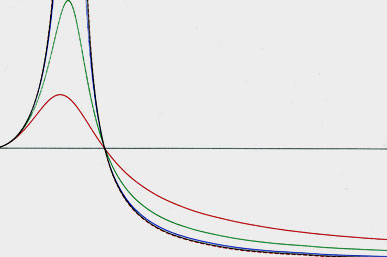
Frequency ratio is the forcing frequency over natural frequency - see the transmissibility curve. The bigger the ratio the better the isolation.
Damping. Different elastomers have different dampening characteristics. For most general applications the lower the material damping is, the better the Isolation, that's why, together with its high mechanical properties Natural rubber is the preferred choice for anti-vibration mountings.
Resonance.
Where the forcing frequency and the natural frequency of the suspended
mass are the same i.e.; the frequency ratio is equal to one, then the
phenomenon known as resonance will occur. This is because the energy in
the forcing motion is in phase with the natural frequency and energy is
stored and builds up in the system.
A good example of this is a
playground swing where pushing the swing in phase the swing ark
increases and the swing gets higher & higher.
The results of resonance can be catastrophic and this condition should be avoided at all times.
The collapse of the Tacoma narrows bridge USA in the 1940s, and more recently the London millennium footbridge, which was closed for two years for repair, were both due to structural resonance.