

In the rail and mass transit sector, vibration is not simply a by-product of operation, it is a critical engineering challenge that directly affects durability, safety, performance and passenger comfort. As these vehicles become more refined through advancements in technology and electrification, the importance for controlled vibration continues to increase.
From high-speed rail networks and metro systems to freight locomotives and rolling stock, these machines are often under continuous dynamic loading during operation. Wheel to rail interaction, track irregularities and bogie movement generate sustained vibration that travels through the chassis. Without effective control, this vibration accelerates fatigue, leading to more frequent and demanding maintenance.
Understanding how vibration behaves in these environments is the first step towards implementing a reliable and validated isolation solution.
Understanding Vibration in Rail Applications
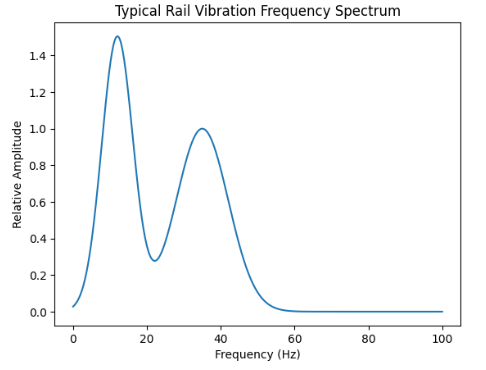
Rail vibration originates primarily from the interaction between the wheel and track. Even minor irregularities create excitation forces that are sent through the bogie and into the carriage structure. These forces are typically characterised by:
-
Low-frequency, high-amplitude oscillations
-
Multi-axis loading (vertical, lateral and longitudinal)
-
Long-duration cyclic stress
Rail Vibration Sources
Rail vibration typically originates from:
-
Wheel–rail interaction forces
-
Track irregularities and surface discontinuities
-
Bogie-induced vertical and lateral oscillations
-
Structural resonance within carriage bodies
Additional vibration sources include onboard equipment such as compressors, HVAC systems, traction motors and auxiliary generators. Structural resonance can occur when excitation frequencies align with natural frequencies of carriage frames or equipment, amplifying vibration levels.
Unlike many industrial systems, rail vehicles experience sustained cyclic loading over extended lifespans. This makes fatigue management and isolation performance critical priorities in engineering.
How Vibration Reduces Durability and Component Lifespan
The primary mechanism through which vibration reduces lifespan is cyclic stress. Every oscillation imposes a fluctuating load on structural and mechanical components. Over time, this repeated loading results in wear and tear and fatigue, including:
-
Cracking can develop in chassis brackets, weld joints and support frames.
-
Bearings experience accelerated wear due to fluctuating loads.
-
Electrical connectors can loosen under consistent vibration.
-
Seals degrade as misalignment increases.
In rail carriages, long-term cyclic stress may contribute to weld fatigue in body structures or mounting points.
The relationship between vibration amplitude and fatigue is exponential rather than linear, meaning fatigue accumulates rapidly as amplitudes increase. This behaviour is described by S-N curves (stress vs. number of cycles to failure), which show that doubling the stress amplitude can reduce fatigue life by an order of magnitude or more. This kind of fatigue life modelling is essential during the design stage.
How Vibration Affects Passenger and Operator Comfort in Rail Systems
Beyond structural integrity, vibration also directly influences passenger and operator comfort. In rail engineering, refinement is measured through Noise, Vibration and Harshness (NVH) performance.
In rail systems, whole-body vibration exposure must be carefully controlled to comply with international standards such as ISO 2631. ISO 2631-1 defines frequency-weighted acceleration limits, with the human body being most sensitive to vertical vibration in the 4–8 Hz range and lateral vibration in the 1–2 Hz range. Comfort thresholds are typically expressed in terms of root mean square (RMS) acceleration: values below 0.315 m/s² are generally considered comfortable, while values above 0.63 m/s² are likely to cause discomfort for the majority of passengers.
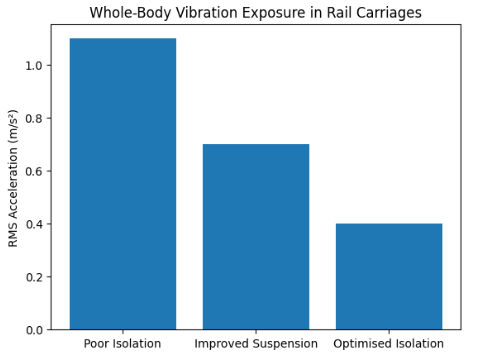
In high-speed rail systems particularly, refinement is a key differentiator. Effective vibration isolation enhances ride stability, reduces cabin noise and improves overall passenger experience.
Structural Safety and Regulatory Considerations
Unmanaged vibration reduces safety margins. Persistent cyclic loading accelerates fatigue in load-bearing components, while mount degradation may compromise structural restraint under emergency conditions such as sudden braking or impact events.
In rail applications, equipment cabinets and auxiliary systems must remain secure under long-term vibrational exposure. Validation through modelling and physical testing ensures that isolation systems do not introduce resonance amplification or compromise safety-critical components.
Anti-Vibration Strategies in Rail Applications
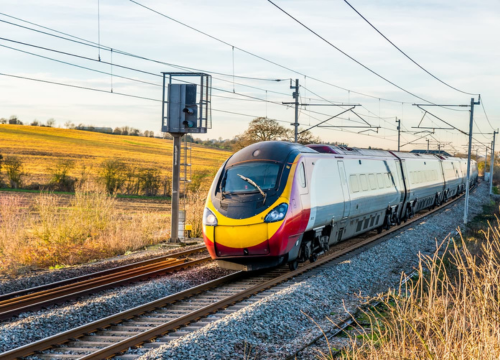
Rail vibration management is more complex than standard anti-vibration strategies due to the size and structure of the vehicles. It is inherently layered and must address both primary and secondary excitation sources.
Primary Suspension Systems
Primary suspension systems manage wheel to rail interaction forces. These systems absorb track irregularities before vibration propagates into the carriage body.
Secondary Suspension and Carriage Isolation
Secondary suspension elements isolate the carriage from bogie-induced vibration, improving ride comfort and reducing structural stress.
Equipment Isolation
Onboard systems such as compressors, HVAC units and generators require compliant mounting systems capable of handling high static loads while isolating low-frequency vibration.
Mounting Solutions
Rail applications typically operate under substantial mass and over long periods. This means that mounts must exhibit high fatigue resistance and durability. Low-frequency isolation often demands higher static deflection characteristics, making mounting solutions critical, including:
-
Spherical Bearings
-
Conical Springs
-
Chevron Springs
-
Conical Mounts
At AV Industrial Products, we can supply products in compliance with EN45545 subject to request.
Material Selection and Engineering Considerations
Material selection plays a defining role in vibration performance. Natural rubber offers high resilience and excellent vibration isolation characteristics, making it suitable for many rail applications. Natural rubber typically exhibits a dynamic stiffness ratio of 1.1–1.4 at low frequencies, rising at higher frequencies. Its loss factor is relatively low at approximately 0.05–0.1, meaning it is efficient at isolating vibration but limited in its ability to attenuate resonant peaks without additional damping measures.
Synthetic compounds may be selected where higher temperature tolerance or fire-retardant properties are required. Nitrile rubber, for example, maintains its mechanical properties over a wider temperature range than natural rubber and offers improved resistance to oils and hydraulic fluids common in traction systems. However, its isolation efficiency is typically lower, with a higher dynamic stiffness ratio.
Engineering decisions extend beyond material choice to include static deflection calculations, natural frequency tuning and hysteresis characteristics. Static deflection and natural frequency are directly related: a mount with 10 mm of static deflection under load will have a natural frequency of approximately 5 Hz, while 25 mm deflection reduces this to around 3 Hz. Achieving isolation at low frequencies therefore requires greater static deflection, which may conflict with space constraints or load rating requirements.Improper material or stiffness selection can result in amplified vibrations, therefore it is important to select correctly or consult with an expert from AV Industrial Products.
Testing, Modelling and Validation
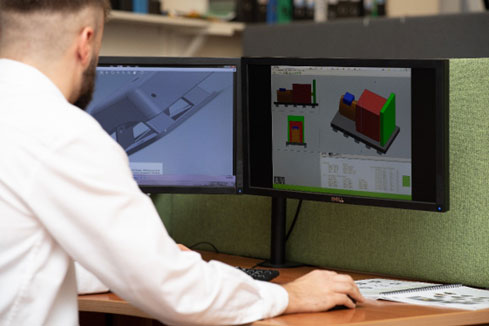
Modern vibration control strategies are driven by data. Finite Element Analysis (FEA), six-degree-of-freedom dynamic modelling and FFT vibration testing allow engineers to quantify frequencies and predict system behaviour.
Finite Element Analysis - used primarily to predict stress distribution and identify areas of potential fatigue initiation under vibrational loading.
Six-Degree-of-Freedom Dynamic Modelling- captures the full translational and rotational behaviour of a mounted system, allowing engineers to predict natural frequencies, mode shapes and transmissibility across the relevant frequency range.
FFT (Fast Fourier Transform) Testing- converts time-domain vibration signals measured on physical hardware into the frequency domain, enabling direct identification of dominant excitation frequencies and comparison against model predictions.
Validation ensures anti-vibration mounts perform under real-world conditions and do not introduce unintended resonance. Prototype validation is particularly important in rail applications due to long service life expectations and safety-critical performance requirements.
How AV Industrial Products Can Help
At AV Industrial Products Ltd, we provide engineering-led anti-vibration solutions tailored to rail and mass transit applications. Our capabilities include vibration testing, computer modelling, material analysis and bespoke anti-vibration mount design.
By combining our technical expertise with validated performance data, we help clients extend machinery lifespan, enhance operational safety and optimise vibration control.
For expert guidance on anti-vibration solutions, get in touch with our engineering team to discuss your requirements.