

Anti-vibration mounts are essential components used throughout the industry to reduce the transmission of vibration from machinery into surrounding structures, equipment and operators. But how do they actually work? Whether installed on engines, generators, compressors or precision equipment, anti-vibration mounts follow the same engineering principles of isolation and damping to control unwanted motion and protect the machinery they support.
Understanding how these mounts work is crucial when designing or maintaining industrial equipment. From rotating imbalance and reciprocating forces to structural resonances and transient shocks, every machine generates vibration. Without an effective isolation system in place, these forces can cause excessive noise, increased wear, reduced accuracy, operator discomfort and long-term structural fatigue.
At AV Industrial Products Ltd, our expertise in vibration control ensures you benefit from precision-engineered anti-vibration mounts that don’t simply fit, but actually isolate, damp and protect against vibration.
Why Vibration Control Matters
When a machine vibrates, energy is being transmitted through its structure. These vibrations may pass from the engine, drive train or motor, through the mount and into the frame and surrounding environment. This transmitted energy causes fatigue, noise, reduced precision and a shorter life. Anti-vibration mounts provide the interface that intercepts that energy, converting and damping it so that the supporting structure remains unaffected.
The Core Principle: Isolation & Damping
At its core, an anti-vibration mount is a mechanical isolation system. It comprises of a dampening element (typically rubber bonded to metal fixings) and sometimes enhanced with fluid or spring elements for tailored performance. The rubber part offers flexibility and energy absorption, whilst the metal fixings provide secure attachment to the equipment and the mounting base.
From a performance perspective, the key parameters are the mount’s natural frequency, damping ratio, stiffness and the excitation frequency of the equipment. To achieve effective isolation, a general rule is that the mount’s natural frequency should be at least half the disturbing frequency of the vibration source.
How AV Mounts Work
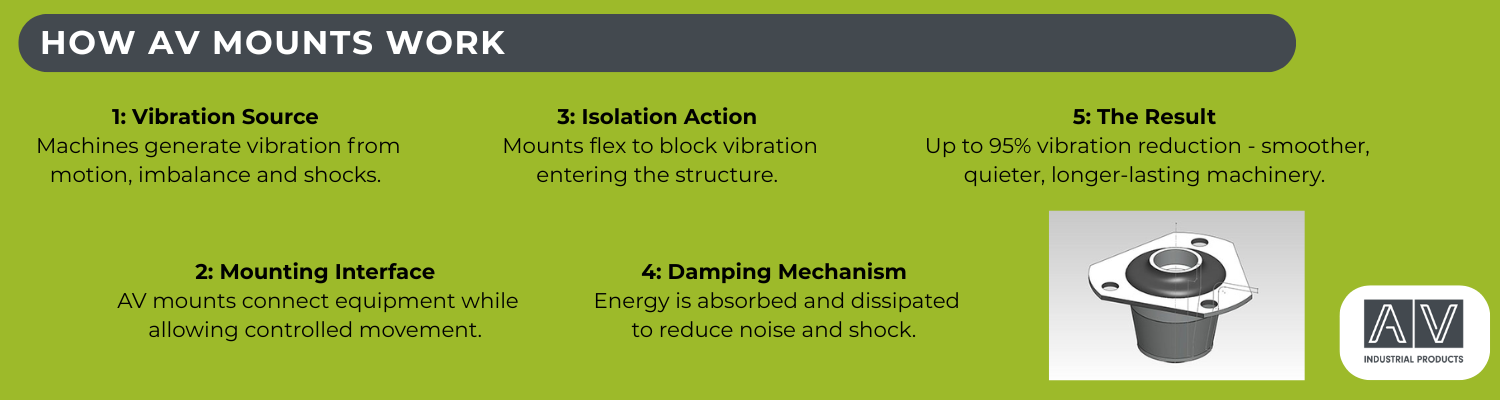
1. Vibration Source - Every piece of mechanical equipment generates some level of vibration. This is typically caused by:
-
Rotating imbalance in motors, alternators, fans and crankshafts
-
Reciprocating motion in engines, compressors, pumps and hydraulic systems
-
Structural resonances within the machine frame or the supporting structure
-
Transient shocks created during start-up, shut-down or sudden load changes
These forces travel through the machine and attempt to pass directly into the chassis, mounting frame or foundation. Without proper isolation, this creates excessive noise, reduced precision, premature fatigue and long-term structural damage.
2. Mounting Interface - Anti-vibration mounts act as a controlled interface between the equipment and its supporting structure. Typically constructed from natural rubber bonded to metal, or in some cases hydraulic or spring-based assemblies, they provide:
-
A secure mechanical connection
-
A compliant element capable of controlled movement
-
A barrier preventing vibration transfer
This interface ensures the equipment remains safely fixed in position while allowing a calculated amount of movement to reduce the direct transmission of vibrational energy.
3. Isolation Action - When vibration is generated, it attempts to travel through the machine into the mount. Here, the first stage of vibration control occurs: isolation.
Anti-vibration mounts are intentionally designed with a lower stiffness than the surrounding structure. This means:
-
The mount deflects slightly, allowing relative movement
-
Less force is transmitted into the base or framework
-
The mount behaves like a mechanical filter, reducing the amplitude of vibration
The amount of isolation achieved depends on:
-
The mount’s natural frequency
-
The dynamic stiffness
-
The frequency ratio between the disturbing vibration and mount characteristics
When the mount is correctly selected, the isolation phase alone can remove a significant proportion of transmitted vibration.
4. Damping Mechanism- While isolation reduces the transmitted force, damping controls and dissipates vibrational energy.
Rubber Mount Damping
Rubber exhibits hysteresis, meaning energy is lost as internal molecular friction when the mount compresses and rebounds. This friction converts vibration into small amounts of heat, effectively absorbing energy that would otherwise be transmitted.
Hydraulic Mount Damping
Hydro mounts incorporate fluid chambers that dampen vibrations. As vibration causes the mount to move:
-
Fluid is forced through calibrated channels
-
The resistance created by fluid movement dissipates vibrational energy
-
High-frequency and transient shocks are significantly reduced
Hydraulic damping is particularly effective for variable-speed applications such as vehicle engines, cabs and generator sets.
Spring Mount Damping
Springs are highly effective for low-frequency isolation but have low inherent damping. To counter this, many spring mounts include:
-
Rubber end caps
-
Friction pads
-
Optional viscous dampers
These additions prevent excessive bounce or resonance and ensure stable performance under fluctuating loads.
5. Result - Once isolation and damping work together, the resulting vibration transmitted into the machinery frame, vehicle chassis or surrounding structure is dramatically reduced. With correctly selected mounts:
-
70% to 95% vibration reduction is typical
-
Sensitive components are protected from premature wear
-
Structural fatigue is reduced
-
Noise levels drop significantly
-
Operator comfort and machine performance improve
-
Reliability and service life increase
This combined effect is why anti-vibration mounts are essential across industries such as power generation, construction, marine, rail, HVAC and precision manufacturing.
For detailed insights, visit our latest article on how our engineering services improve equipment performance.
Types of Anti-Vibration Mounts and How They Work

Rubber Bobbin and Rubber Mounts– Using natural or synthetic rubber bonded to metal fixings, rubber bobbin mounts provide effective isolation for high-frequency vibration and are widely used across industrial machinery, generators and engines
Hydro or Fluid-Damped Rubber Mounts– Combine a rubber element with a viscous damper. Hydro mounts excel where vibration frequencies vary or come with high shocks such as in vehicle cabs or engines subject to transit loading.
Spring Mounts– Made with steel coil springs and sometimes combined with rubber elements. These are tuned for low-frequency vibration and high static deflection (slow-speed machines, large fans, HVAC systems).
Cone Mounts / Captive Transit Mounts– Designed to control movement in multiple axes under high shock or mobile applications (vehicle cabs, off-highway equipment). Cone mounts and captive transit mountsfollow the same isolation-and-damping principle, but are tailored to the vibration frequency, shock level and load of the application.
Why Correct Selection Matters
Poorly selected or installed mounts can do more harm than good. Incorrectly chosen mountings may amplify vibration, underperform in application or degrade equipment faster. At AV Industrial, our engineering team uses finite element analysis (FEA), six-degree-of-freedom modelling and on-site vibration surveys to validate mount design.
Selecting the right mount means balancing load, deflection and frequency. For example, the static deflection of a mount (δ = Load / Stiffness) must allow adequate motion for isolation without excessive movement that would affect stability. Also, special rubber compounds must be chosen when oil, fuel swell or extreme temperatures are present.
Real-World Benefits of Effective Mounting
When properly applied, anti-vibration mounts deliver multiple measurable gains:
-
Reduced vibration transmission– less fatigue, less structural damage.
-
Extended equipment life– fewer failures, bearing damage or loosened fixings.
-
Lower noise levels– enhanced operator comfort and compliance with regulations.
-
Improved reliability– less unplanned downtime and maintenance.
These are outcomes we regularly deliver for clients across power generation, marine & offshore, rail and mass transit and industrial machinery sectors.
Why Integration Is Key
The best performance is achieved when vibration isolation is integrated at the design stage, not added afterwards. At AV Industrial Products, we advocate for early collaboration so that mount selection, modelling and testing are built into equipment or vehicle development, avoiding costly retrofits and performance compromises later.
How AV Industrial Products Can Help
Here at AV Industrial Products Ltd, we design, manufacture and supply a broad range of anti‐vibration mounts. From small instrument mounts supporting under 1 kg to heavy-duty mounts capable of 30 tonnes and more, we’re constantly fine-tuning and improving our equipment.
Our services go beyond product supply: we offer site surveys, vibration testing, computer modelling, bespoke rubber compound analysis and full mount specification support. Whether you require standard mounts or bespoke engineered solutions, our applications engineers are ready to assist you.
For more information on how anti-vibration mounts work, or to discuss the right solution for your equipment, please get in touch with our team.